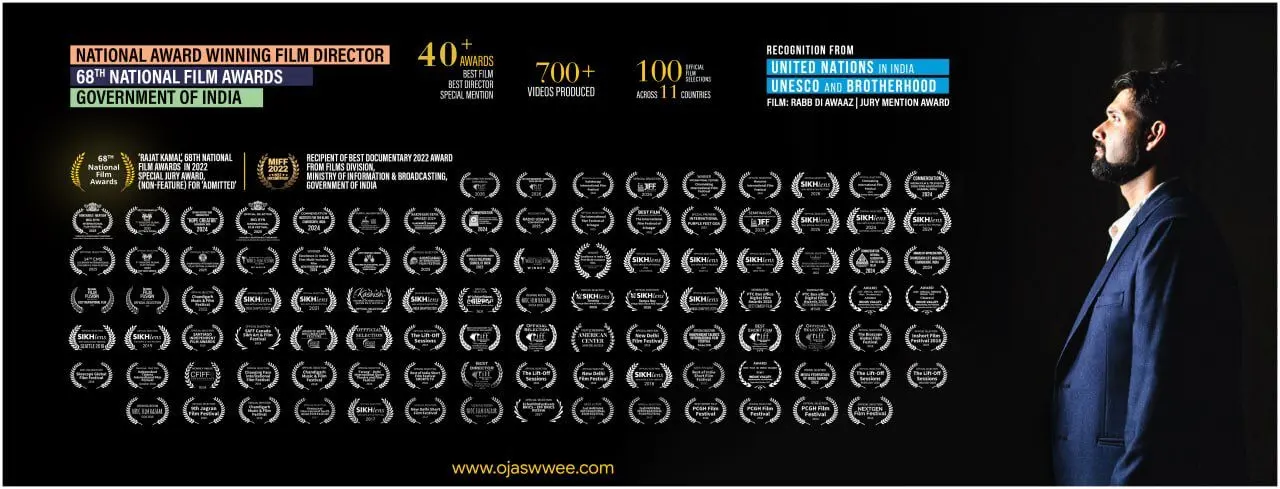
Film Director, and Film Producer | Contributor to Global and Indian Cinema, Cinema Leadership, Inclusive Cinema and Accessible Cinema
National Award-Winning Film Director from India | Recipient of the ‘Rajat Kamal’ & Special Jury Award at 68th National Film Awards 2020 from the President of India in 2022 | Awarded by the United Nations in India, UNESCO & Brotherhood in 2025 | Awarded twice by Ministry of Information & Broadcasting (MIB), Govt of India in 2022 | PRCI Chanakya Award 2023 | Awarded twice by the Media Federation of India in 2022 & 2024 | 4 times India’s Regional PR Awards (IRPRA) Recipient 2021, 2022, 2023 & 2025 | Honored by the Rotary International President-Elect (2026-27) in 2026
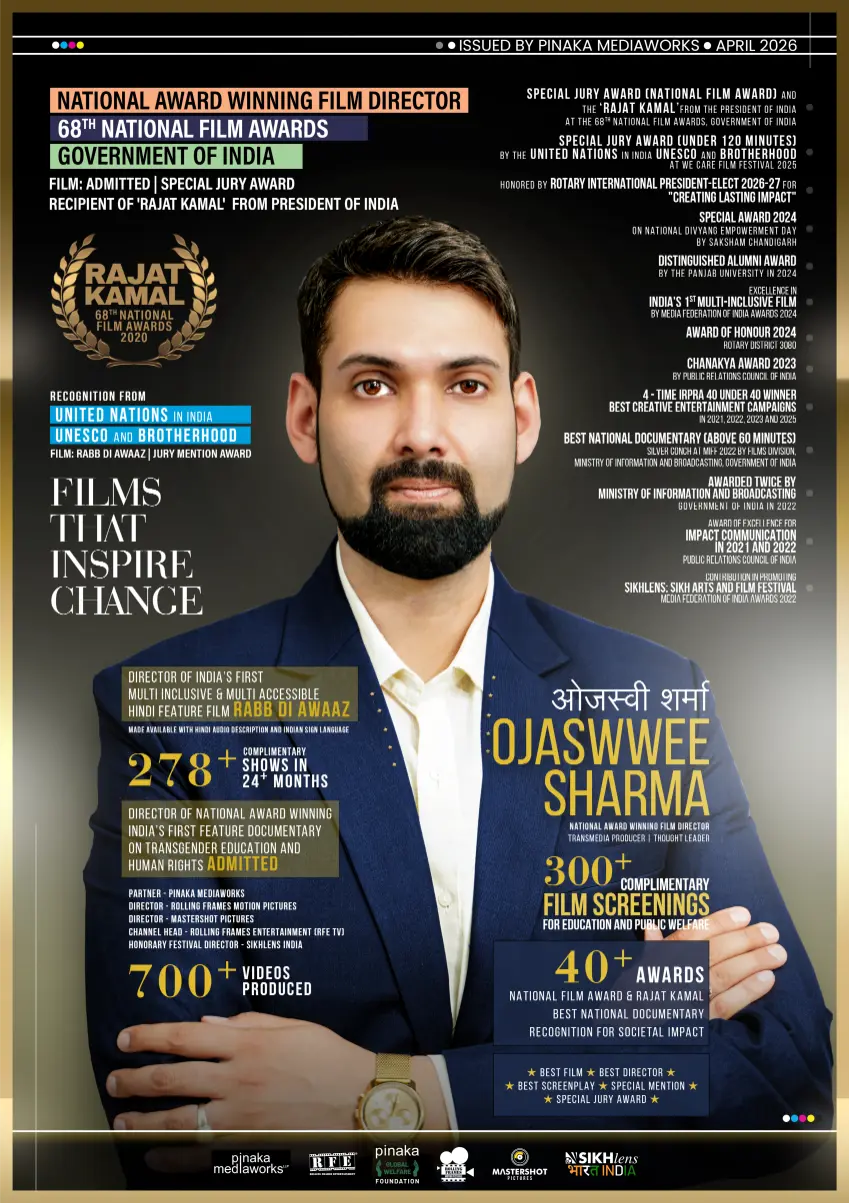
Click on the Poster to Enlarge
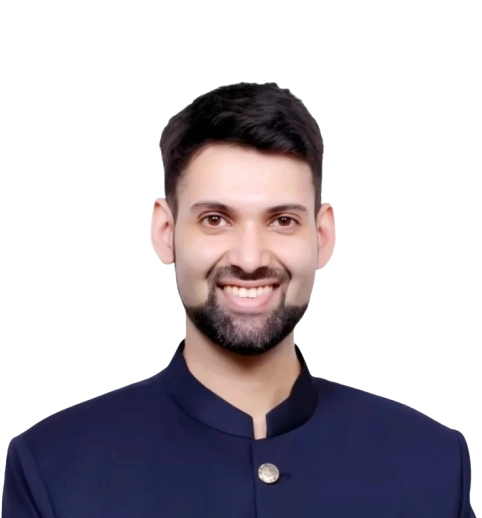
Ojaswwee Sharma is a National Award-winning Film Director, Producer, and Screenwriter from India. His work and contributions have established him as a thought leader in modern cinema. Till date, his work is known for blending cultural storytelling with impactful social themes, addressing key issues such as inclusivity, mental health, human rights, social justice and societal awareness. His work reflects a dedication to meaningful storytelling.
Ojaswwee Sharma’s cinematic journey showcases his passion for films that not only entertain but also provoke thought and inspire change and addressing societal challenges with sensitivity and nuanced story-telling. His notable works include ‘Rabb Di Awaaz’, ‘Admitted’, ‘Zubaan’, ‘Chaurassi’, and ‘The Last Date’.
His work has been lauded for raising awareness of critical social issues and for its sensitive and in-depth exploration of challenging themes. His films have been screened at numerous film festivals and have garnered a wide viewership, captivating audiences across India and internationally.
Ojaswwee Sharma’s oeuvre includes the groundbreaking film ‘Rabb Di Awaaz’, India’s first multi-inclusive Hindi feature film certified in multiple-accessible formats by the Central Board of Film Certification (CBFC), including versions for the persons with visual and hearing impairment. This film incorporates subtitles, Hindi audio descriptions for audiences with visual impairment, and Indian Sign Language for viewers with hearing impairment. It has been showcased at more than 278 screenings in over 24 months after release, and has won praise for raising awareness of mental health, disability, inclusivity, and accessibility in Indian society. This film has set a benchmark for accessible cinema and significantly contributed to accessibility policy in the public exhibition of films in India. It was recognised with the Special Jury Mention by the United Nations in India, UNESCO and Brotherhood at the We Care film festival (2025), and as the Best Film on Disability at the World Film Festival, Cannes (2024). The film was invited by the Office of the State Commissioner for Persons with Disabilities, Government of Goa for the International Purple Fest Goa 2025. It received the best film award from the Media Federation of India in 2024, and was recognized by SAKSHAM on National Divyangjan Empowerment Day, also in 2024.
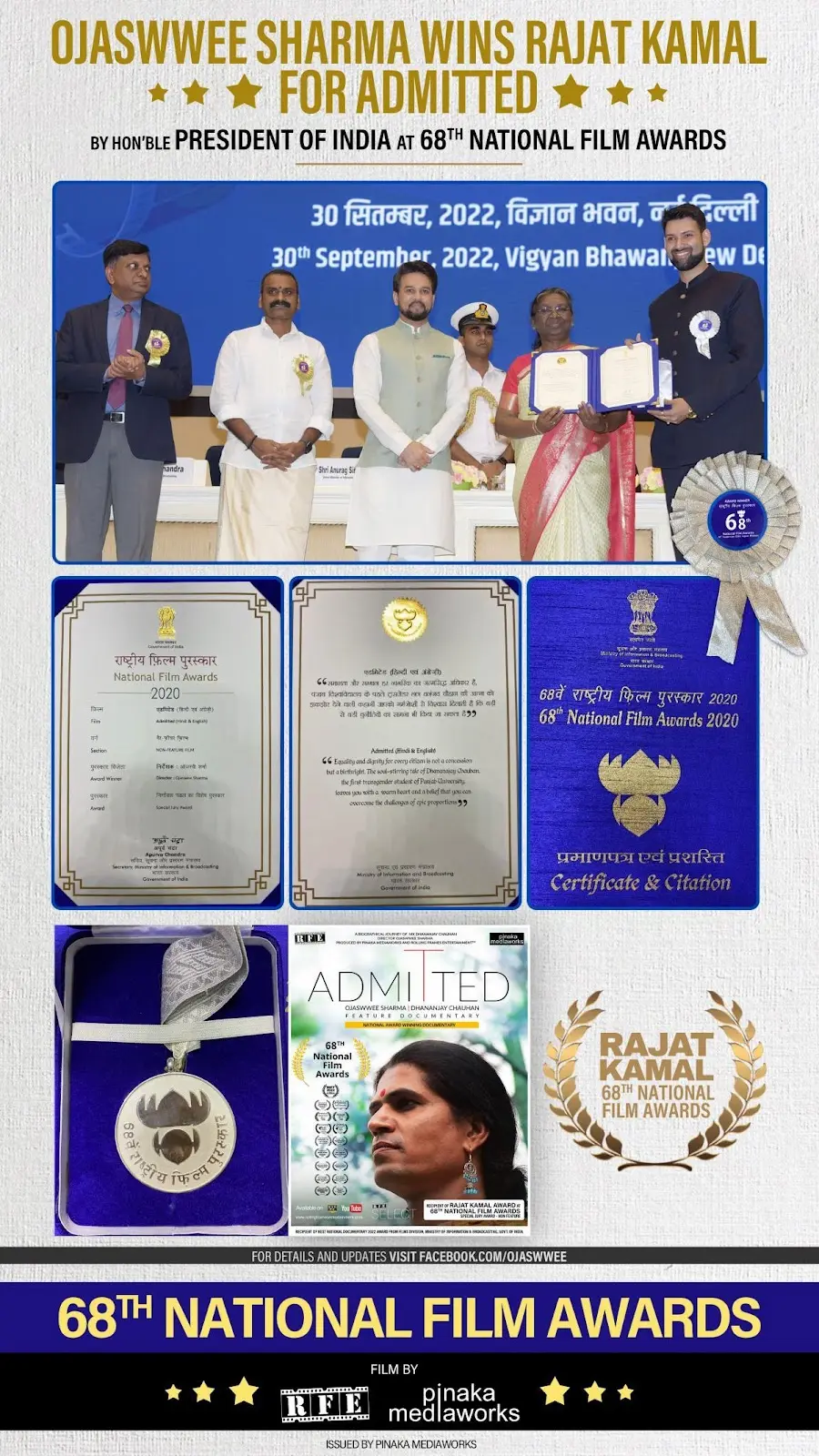
Ojaswwee Sharma’s work has received significant recognition from the Government of India. He has been honoured twice by the Ministry of Information & Broadcasting, first at the 68th National Film Awards 2020 by the Government of India with the National Award – ‘Special Jury Mention’ for the film ‘Admitted’ and the Rajat Kamal at the by the 15th President of India, Smt. Droupadi Murmu on 30th September 2022, and second, with the Silver Conch for the Best Feature Documentary of the Year 2022 by the Films Division on 4th June 2022 for the film ‘Admitted’. His film ‘Admitted’ marked his major international breakthrough. This documentary highlights the case of transgender education and positive developments, such as the establishment of a transgender washroom at Panjab University. It was filmed through the biographical perspective of the first transgender student of Panjab University, who went on to become the first transgender student ever to be admitted to any public university in India.
In 2026, Ojaswwee Sharma was honored in Chandigarh by Rotary International President-Elect 2026-27 Olayinka Hakeem Babalola during his visit to India in April 2026.
My Story
Taking Indian Narratives to Global Platforms
Ojaswwee Sharma has brought Indian narratives to global audiences through his production companies, Pinaka Mediaworks, Rolling Frames Motion Pictures, MasterShot Pictures, and Digital Distribution Network: RFE TV Rolling Frames Entertainment. His films have been represented in more than 18 countries across almost every continent, including Asia, North America, Canada, Russia, the European Union, Africa, and Australia.
As a filmmaker and educator, Ojaswwee Sharma is contributing to the future generation of Indian cinema, providing a platform for progressive, cultural, and rooted narratives from India. His work has positively and significantly impacted and contributed to the national film landscape of India through his filmography and his efforts in spreading awareness of film education and employment in film development.
In addition to film-making, Ojaswwee Sharma is the driving force behind the India chapter of Sikhlens: Sikh Arts & Film Festival. Serving as its Festival Director since 2020, he has successfully curated six annual editions in Chandigarh from 2020 to 2026, offering free access to audiences and celebrating diverse and meaningful storytelling. He has also produced impactful campaign work, including films for several non-profits, healthcare initiatives and social awareness for various initiatives and programs of Sikhlens.
His films have received wide acclaim and numerous awards, including over 100+ official selections and more than 40 awards for films and acknowledgement of leadership practices. Awards include Best Film, Best Director, Best Actor, and Critics’ Choice Awards for films such as India’s first multi-inclusive Hindi feature film, Rabb Di Awaaz, the National Award-winning Admitted, the 18-award-winning film Zubaan, and the 12-award-winning film The Last Date, among the notable ones.
Ojaswwee Sharma’s vision remains steadfast: to use cinema as a tool for societal change, bridging social divides, and bringing untold Indian societal perspectives to the global stage. Through his thought-provoking films and unwavering dedication to inclusivity, he continues to redefine modern Indian cinema and its role in fostering a progressive, empathetic, and united society.
Ojaswwee Sharma’s is the first film director from Chandigarh to be conferred the National Film Award at the 68th National Film Awards by the Government of India. Notably, more than 90% of his award-winning work was filmed in Chandigarh, which he has formally declared as the working headquarters for his film production. His projects extensively feature talent and participants from the Tricity (Chandigarh, Panchkula, and SAS Nagar) and the adjoining states of Punjab, Haryana, and Himachal Pradesh, Uttarakhand, New Delhi reflecting his deep-rooted commitment to the region’s creative ecosystem.
Significant Recognitions
Ojaswwee Sharma’s career is marked by numerous significant recognition’s, including:
- Special Jury Award (National Film Award) and the ‘Rajat Kamal’ from the President of India at the 68th National Film Awards, Government of India.
- Jury Mention Award (Under 120 minutes) for the Film Rabb Di Awaaz by United Nations at We Care Festival 2025 held in New Delhi.
- Honored by Rotary International President-Elect 2026-27.
- Chanakya Award 2023 by the Public Relations Council of India.
- Best National Documentary (Above 60 minutes) Silver Conch at MIFF 2022 by Films Division, Ministry of Information and Broadcasting, Government of India.
- Distinguished Alumni Award with Citation from Panjab University Alumni Association in 2024 and from Chitkara University in 2022.
- 4 – Time IRPRA 40 Under 40 in 2021, 2022, 2023 and 2025.
- Special Award 2024 on National Divyang Empowerment Day from SAKSHAM.
- Recognised in 2022 and 2024, respectively by the Media Federation of India.
Highest Recognition
Key Highlights:
- Produced and directed National Award-winning film ‘Admitted’ and India’s first multi-inclusive and fully accessible Hindi feature film ‘Rabb Di Awaaz’.
- Received the National Award in 2022 for the film ‘Admitted’ from the President of India at the 68th National film Awards.
- Directed India’s first multi-inclusive Hindi feature film, ‘Rabb Di Awaaz’, certified in multiple-accessible formats.
- Films have been screened at numerous film festivals and have garnered a wide viewership across India and internationally.
- Films have been lauded for raising awareness of critical social issues and for their sensitive and in-depth exploration of challenging themes.
- Contributed to the development of cinema from North India, specifically the regions of Chandigarh, Punjab, New Delhi, Haryana, and Himachal Pradesh Gujarat , promoting diversity of culture and language.
- Created and produced film festivals for Sikhlens in India on interfaith storytelling for 7 consecutive years (2020, 2021, 2022, 2023, 2024, 2025, 2026).
- Contributed to policy implementation for “Accessibility Standards in the Public Exhibition of Feature Films in Cinema Theatres for Persons with Hearing and Visual Impairment”, by Government of India’s Ministry of Information and Broadcasting.
- Organized free film screenings of feature films for education in rural schools and colleges, and special institutions.
- Contributed to various sustainable development goals, including good health and well-being (SDG-3), quality education (SDG-4), gender equality (SDG-5), decent work and economic growth (SDG-8), reduced inequalities (SDG-10), and fostering crucial partnerships for the goals (SDG-17), and affordability of cinema.
- Particiapted in Stakeholder consultation on certification of multi-language films by Central Board of Film Certification on Pan-India Films.
- Contributed to and Addressed hundreds of Academic and Non-Academic Institutions across various states of North and West India on the Role of Cinema in Education, Films and Social Impact, Accessibility of Indian Cinema, exploring Cinema as a Career, Film Criticism, Film Appreciation, and sharing experience based on producing films such as Rabb Di Awaaz, Admitted, Zubaan and The Last Date. In this context, addressed Middle Schools, Secondary Schools, Higher Secondary Schools, Private and Govt Colleges, Private and Govt Universities, Non-Profits, NGOs, Corporate and Cultural Institutions.
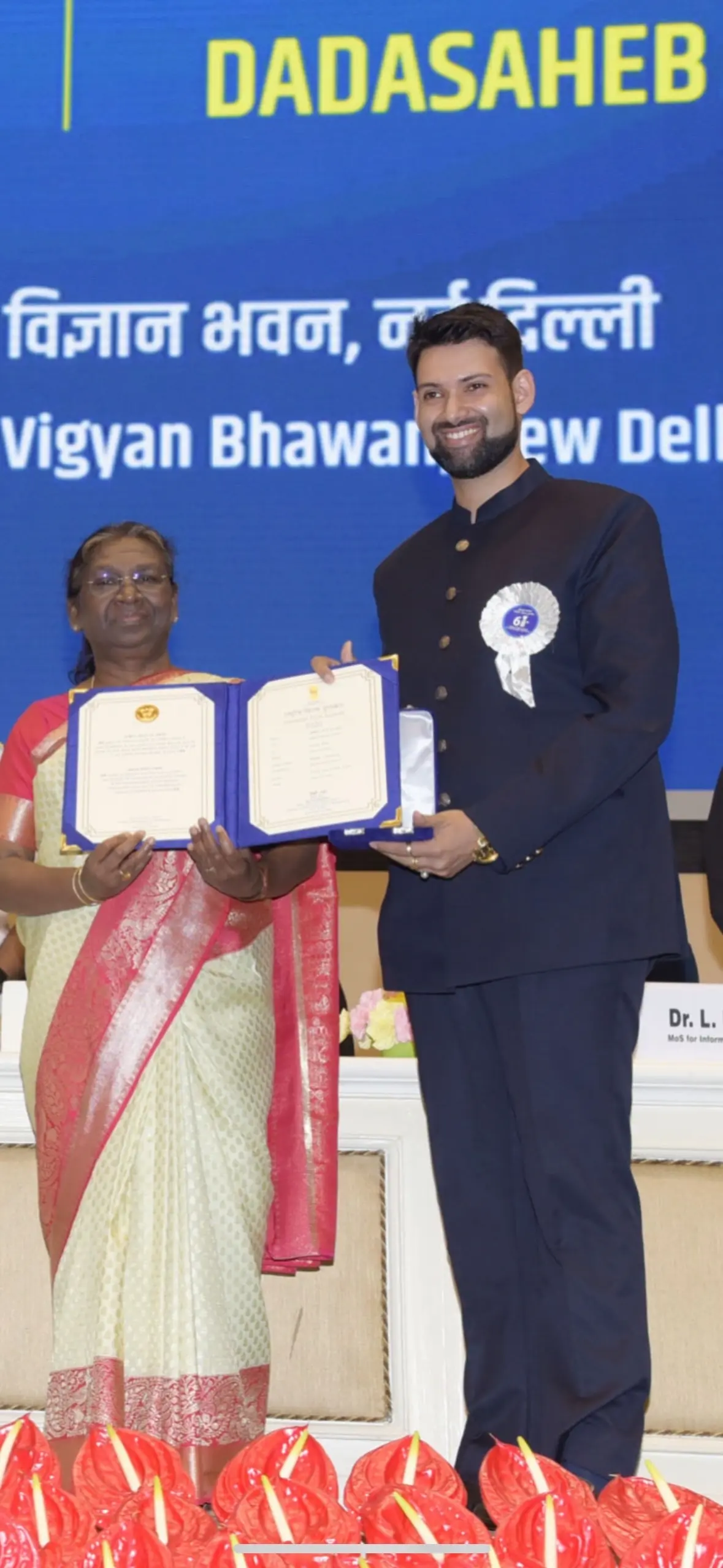
- Special Jury Award and ‘Rajat Kamal’ at 68th National Film Awards from the 15th President of Republic of India and the Ministry of Information & Broadcasting, Government of India, for Film: Admitted (2022).
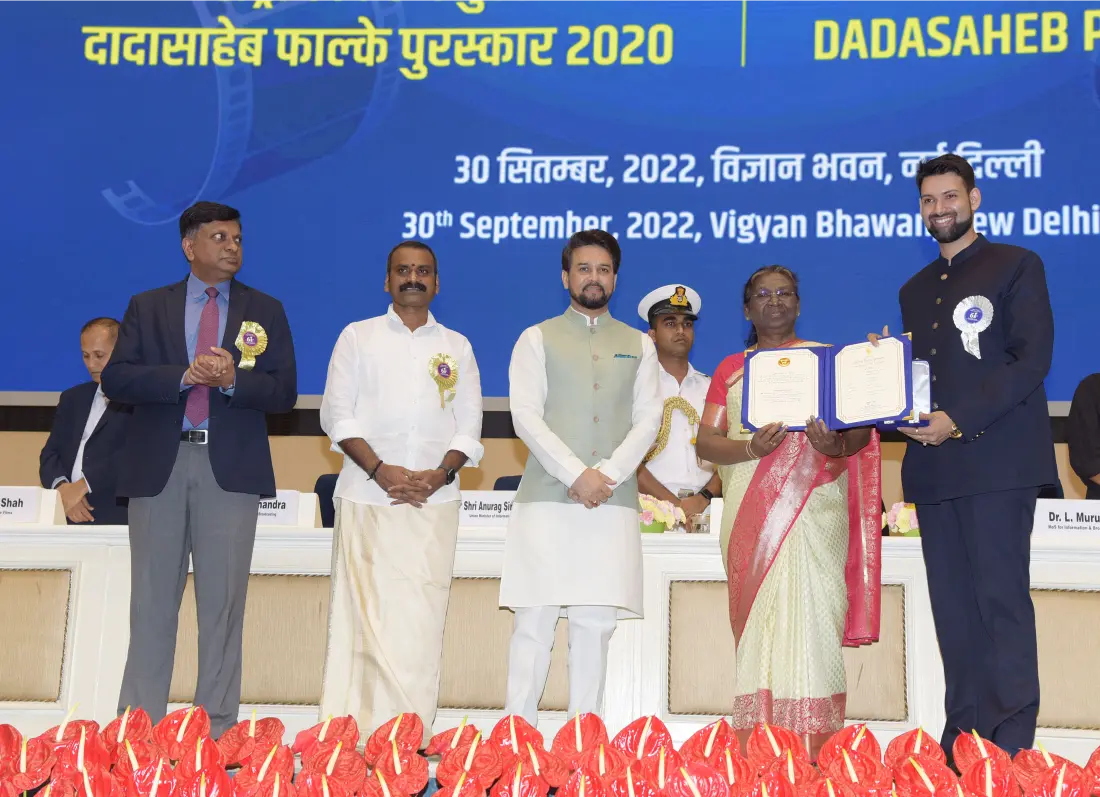
Photograph Issued by : Press Information Bureau, Government of India
Received the National Award and the Rajat Kamal at the 68th National Film Awards ceremony on September 30, 2022 in New Delhi at the Vigyan Bhavan from the 15th President of India Smt. Droupadi Murmu, Sh Anurag Singh Thakur (Union Minister for Information & Broadcasting), Dr. L Murugan (Minister of State in the Ministry of Information & Broadcasting), Shri Apurva Chandra, IAS, Secretary in the Ministry of Information & Broadcasting | Photo issued by: Photo Division, Press information Bureau, Government of India.
- Special Jury Award (Under 120 minutes) for the Film Rabb Di Awaaz by United Nations, UNESCO and Brotherhood at We Care Festival 2025 held in New Delhi.
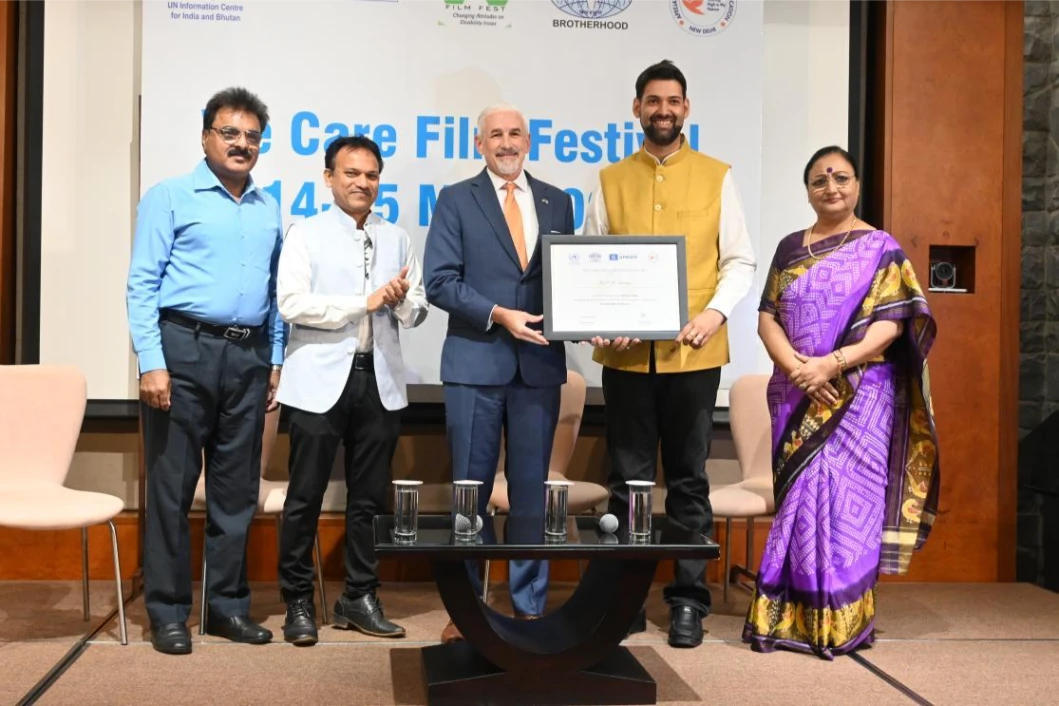
The award was presented by a distinguished panel including Shombi Sharp, UN Resident Coordinator for India; Guruprasad R. Pawaskar, State Commissioner for Persons with Disabilities, Government of Goa; Dr. Mallika Nadda, President of Special Olympics Bharat and Chairperson of the Special Olympics Asia Pacific Advisory Council; and Satish Kapoor, Founder of Brotherhood and the We Care Film Festival.

Citation of the recognition for “Rabb Di Awaaz”, citing name of the film, Jury Mention Award
‘Up to 120 minutes category”,
Name of the Festival: We Care Film Festival 2025
- Best National Documentary (Above 60 minutes) Silver Conch at MIFF 2022 by Films Division, Ministry of Information and Broadcasting, Government of India.
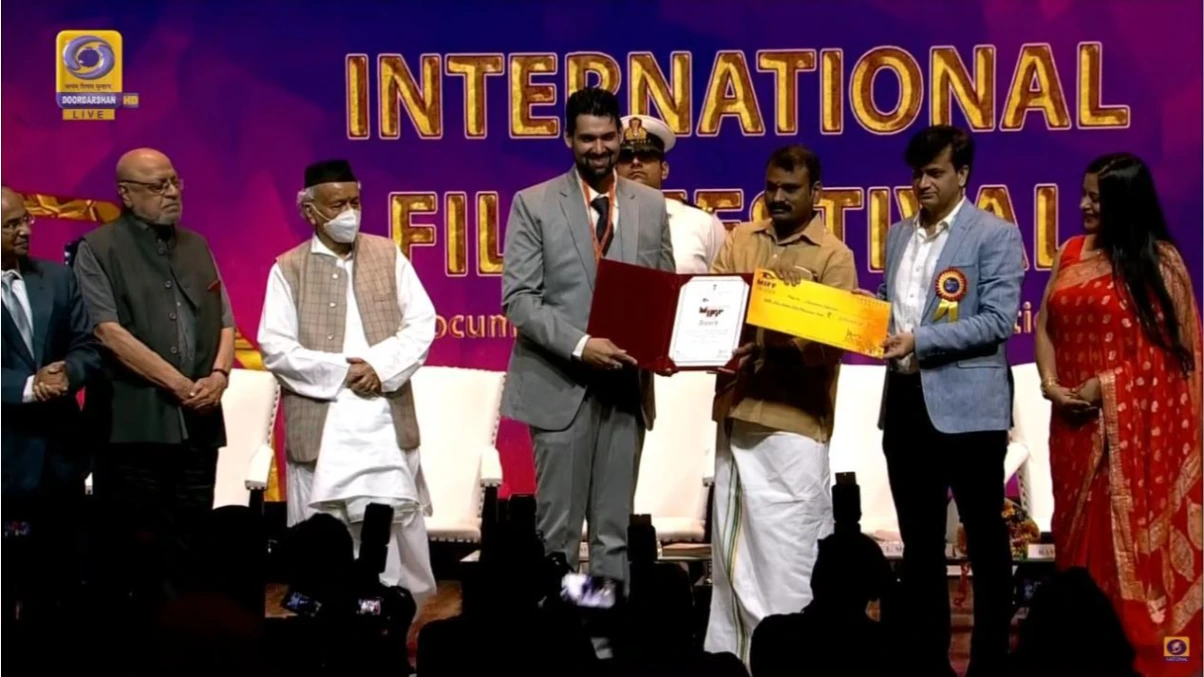
Official Photograph of Ojaswwee Sharma Receiving the Best Documentary Award, the Silver Conch for the film “Admitted” at the 68th National Film Awards from Dr. L Murugan – Minister of State, Information & Broadcasting on June 2, 2022.
Right To Left : Smt Mona Sharma, Shri Ravinder Bhaker – CEO of the Central Board of Film Certification, Dr. L Murugan – Minister of State, Information & Broadcasting, Shri Shri Bhagat Singh Koshyari 22nd Governor of Maharashtra, Late Shri Shyam Benegal, Padma Bhushan, Padma Shri
Photo issued by: Doordarshan, Government of India.
Vision and Future Path
Ojaswwee Sharma is dedicated to advancing the landscape of Indian cinema through a multi-faceted approach centered on quality, innovation, and profound societal impact. His vision transcends mere entertainment, actively leveraging the power of storytelling to foster deeper understanding and critical appreciation.
Key Pillars of His Vision:
- Cultivating Quality Cinema: A relentless pursuit of excellence in filmmaking across diverse formats, ensuring compelling narratives, high production values, and transformative cinematic experiences that audiences will value and recognize.
- Films as Catalysts for Social & Cultural Impact: Enhancing the role of films and campaigns in fostering critical societal and cultural awareness and consciousness on themes ranging from interpersonal relations and education to healthcare, environmental stewardship, and interfaith understanding, aiming to inspire meaningful dialogue and cultivate discerning audiences that appreciate cinema’s potential for impact.
- Empowering Youth in Film: A strong commitment to developing and enhancing skill sets among aspiring young talents in various aspects of film production, thereby nurturing future generations who will contribute to highly appreciated cinema.
- Globalizing Indian Perspectives & Overcoming Linguistic Barriers: Utilizing cinema as a powerful tool for bridging cultural divides and bringing authentic Indian narratives and societal insights to the global spotlight, specifically by addressing and integrating diverse linguistic nuances for wider reach, thereby cultivating global appreciation for the richness and depth of Indian storytelling.
- Bridging Cinema and Education: Actively fostering a symbiotic relationship between filmmaking and educational initiatives, allowing cinema to serve as both a medium for learning and a subject of academic exploration, thereby deepening its appreciation in intellectual and creative spheres.
- Fostering Independent Cinema Viability: Dedicated to creating and strengthening marketplaces and distribution channels that foster the sustained recognition and broader reach of independent films, allowing diverse voices to gain critical and audience appreciation.
- Building a Collaborative Consortium: Committed to establishing a healthy and supportive ecosystem for film technicians and artists, promoting fair practices, fostering professional growth opportunities, and nurturing a collaborative environment that empowers talent across all aspects of film-making, leading to higher quality and more appreciated cinematic works.
Vision for 2030
Despite the continually evolving landscape of the industry, Ojaswwee remains steadfast in his vision of inclusive and Impactful storytelling. He firmly believes that the success of a film transcends any single element—be it a brilliant script, a talented actor, or high production value. Instead, it is born from the synergistic alignment of all these components. His role as a director is akin to that of a captain steering a ship, meticulously ensuring that every aspect of the film harmonizes with the larger creative and social vision.
By 2030, Ojaswwee envisions a transforming cinematic landscape in India where films are recognized as robust catalysts for fostering social consciousness, equitable representation, and greater accessibility for all, leading to a profound appreciation of their civic and cultural value. His goal is to cultivate an industry that deeply embraces authentic storytelling, actively provides fair opportunities to underrepresented communities, and integrates accessibility as a fundamental principle across all stages of production and exhibition. This evolution will see the conventional distinction of ‘parallel cinema’ fade, as quality, meaningful, and culturally resonant storytelling becomes the celebrated mainstream. This includes fostering sustainable models that enable independent filmmakers to gain significant critical and audience appreciation, ensuring diverse voices reach wider audiences by effectively navigating linguistic and cultural nuances.
Ultimately, his vision extends beyond traditional entertainment to forge a dynamic media ecosystem that educates, inspires, and contributes to informed public discourse, ensuring that cinema is profoundly appreciated as a powerful instrument for empowerment and sustained societal reflection.